
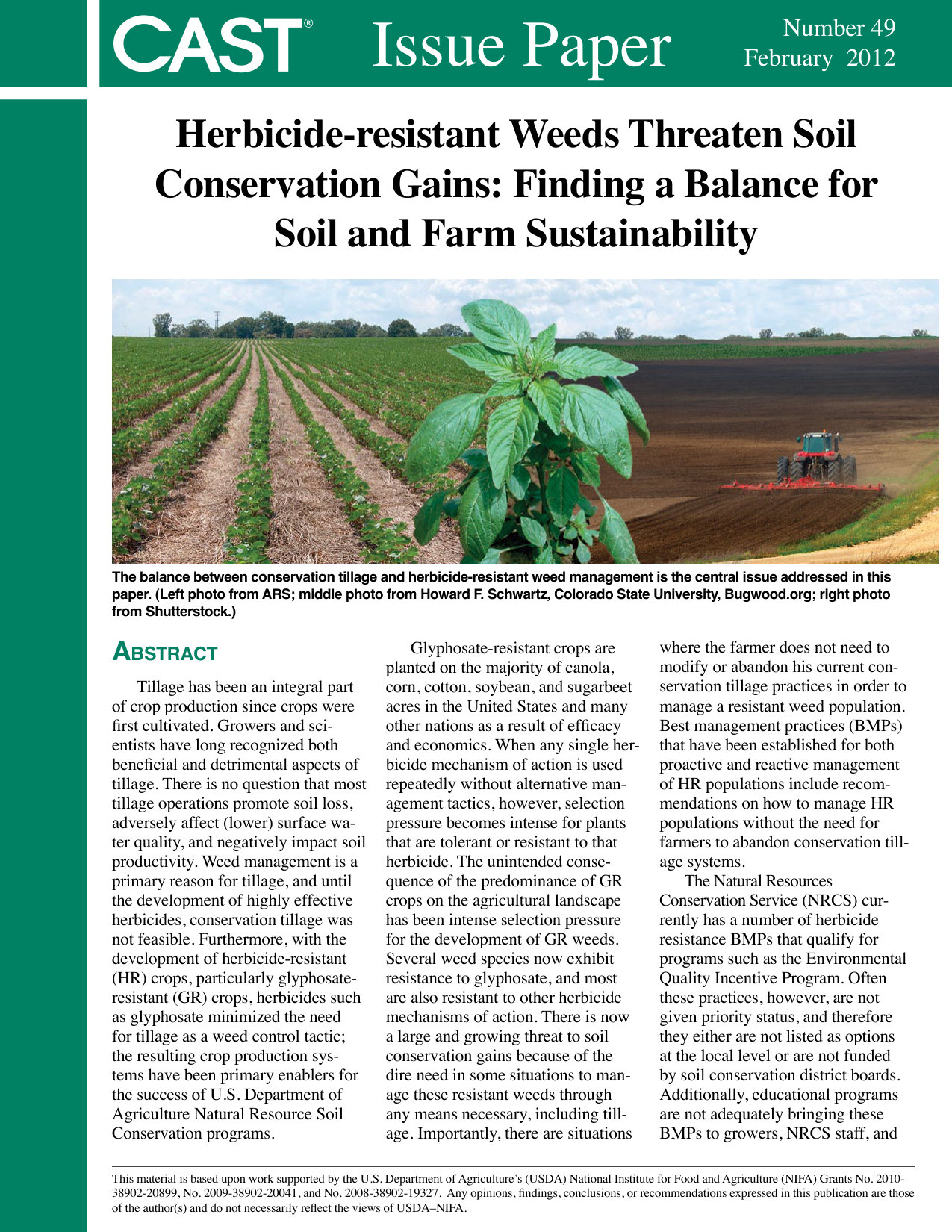
Herbicide-resistant Weeds Threaten Soil Conservation Gains: Finding a Balance for Soil and Farm Sustainability
DOI:
https://doi.org/10.62300/d926r629Keywords:
Herbicide Resistance, Soil Sustainability, Soil ConservationAbstract
Herbicides were developed during the twentieth century to be used with conventional tillage for weed control. Conservation (or minimum) tillage subsequently evolved, which enabled less soil damage when used with herbicides. Selection pressure, however, has resulted in weed species that have made adaptations for survival in conjunction with tillage. The U.S. government has put several federal policies and programs in place that help determine the selection and implementation of crops and conservation programs in relation to herbicides and tillage. This Issue Paper (IP 49) examines the impact of certain weed management practices on soil conservation objectives and addresses ways to mitigate negative effects.Downloads
Download data is not yet available.
Downloads
Published
2013-05-15
Issue
Section
Issue Papers
License
Copyright (c) 2013 Council for Agricultural Science and Technology (CAST)

This work is licensed under a Creative Commons Attribution-NonCommercial 4.0 International License.
License Terms for CC Attribution-NonCommercial 4.0:
License URL: https://creativecommons.org/licenses/by-nc/4.0/
License Terms Statement:
You are free to:
- Share — copy and redistribute the material in any medium or format
- Adapt — remix, transform, and build upon the material
Under the following conditions:
- Attribution — you must give appropriate credit, provide a link to the license, and indicate if changes were made
- NonCommercial — you may not use the material for commercial purposes
No additional restrictions — you may not apply legal terms or technological measures that legally restrict others from doing anything the license permits.
How to Cite
Shaw, D. R., Culpepper, S., Owen, M., Price, A., & Wilson, R. (2013). Herbicide-resistant Weeds Threaten Soil Conservation Gains: Finding a Balance for Soil and Farm Sustainability. Council for Agricultural Science and Technology (CAST). https://doi.org/10.62300/d926r629