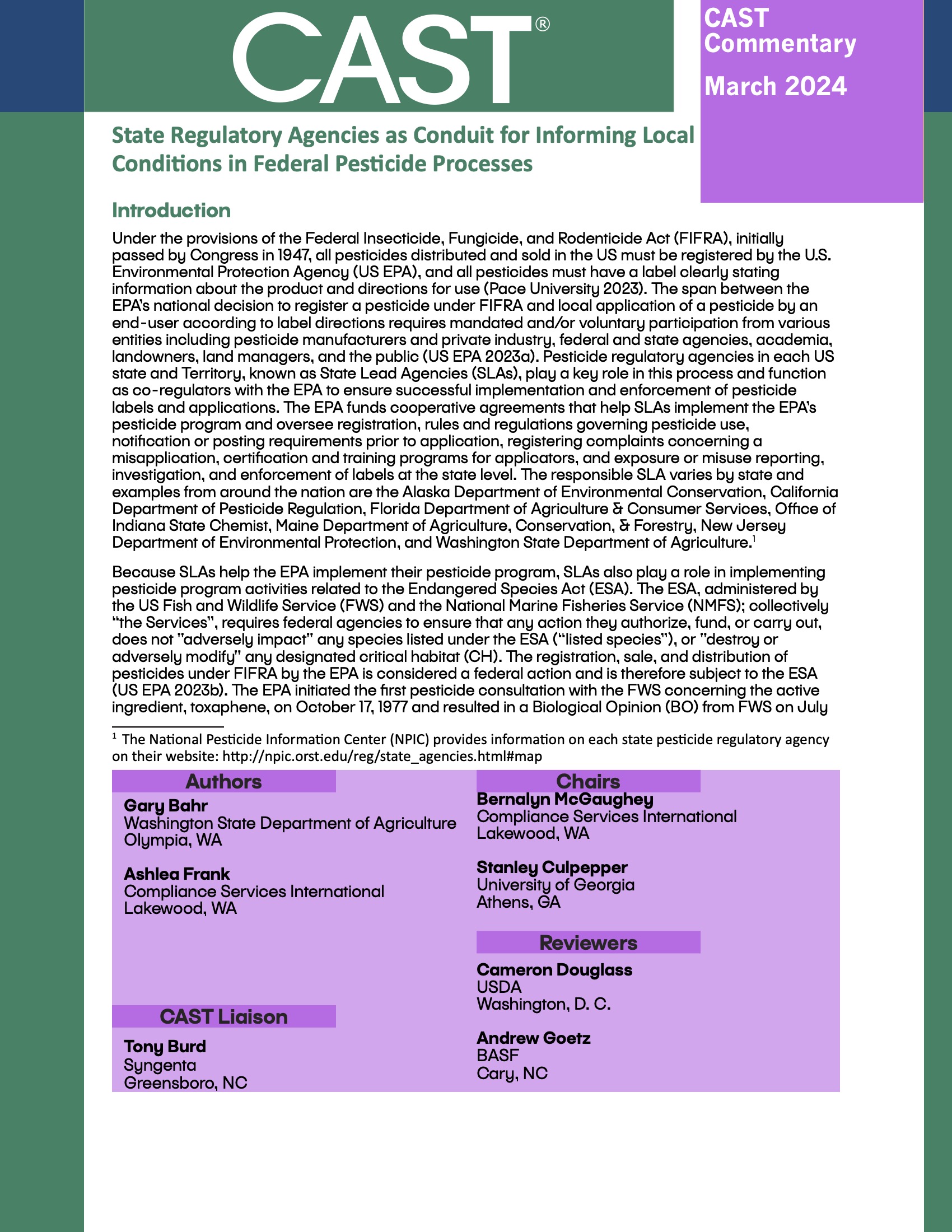
State Regulatory Agencies as Conduit for Informing Local Conditions in Federal Pesticide Processes
DOI:
https://doi.org/10.62300/p34cbm48Keywords:
FIFRA, Endangered Species Act (ESA), State Lead Agencies (SLAs), Pesticide Regulation, EPA ESA Workplan, Endangered Species Protection Program (ESPP), Bulletins Live! Two (BLT), Pesticide Certification and Training (C&T), Compliance and Enforcement, Listed Species ProtectionAbstract
This paper examines the intersection of the Federal Insecticide, Fungicide, and Rodenticide Act (FIFRA) and the Endangered Species Act (ESA), focusing on the role of State Lead Agencies (SLAs) in implementing pesticide programs that comply with ESA requirements. It outlines the historical context of FIFRA and ESA integration, including the development of the Endangered Species Protection Program (ESPP) and the EPA’s ESA Workplan. The discussion emphasizes the importance of early SLA engagement in federal pesticide processes to ensure practical, enforceable mitigation measures for protecting listed species and critical habitats. Recommendations include improving communication, training, and enforcement strategies, as well as forming collaborative workgroups to address emerging compliance challenges. The paper concludes that SLAs are uniquely positioned to serve as conduits for local conditions and end-user perspectives, which are essential for successful implementation of ESA-related pesticide measures.
Downloads
References
Pace University. 2023. Federal Insecticide, Fungicide, and Rodenticide Act (FIFRA): Overview. Retrieved from https://libraryguides.law.pace.edu/FIFRA.
U.S. Environmental Protection Agency (US EPA). 2005. Endangered Species Protection Program Field Implementation. 70 Federal Register 66392, 70(211).
U.S. Environmental Protection Agency (US EPA). 2017. Pesticides; Certification of Pesticide Applicators. Retrieved from https://www.federalregister.gov/documents/2017/01/04/2016-30332/pesticides-certification-of-pesticide-applicator.
U.S. Environmental Protection Agency (US EPA). 2021. 2022-2025 FIFRA Cooperative Agreement Guidance. Retrieved from https://www.epa.gov/sites/default/files/2021-02/documents/2225guidance.pdf.
U.S. Environmental Protection Agency (US EPA). 2022a. Balancing Wildlife Protection and Responsible Pesticide Use: How EPA's Pesticide Program Will Meet its Endangered Species Act Obligations. Retrieved from https://www.epa.gov/system/files/documents/2022-04/balancing-wildlife-protection-and-responsible-pesticide-use_final.pdf.
U.S. Environmental Protection Agency (US EPA). 2022b. ESA Workplan Update: Nontarget Species Mitigation for Registration Review and Other FIFRA Actions. Retrieved from https://www.epa.gov/system/files/documents/2022-11/esa-workplan-update.pdf.
U.S. Environmental Protection Agency (US EPA). 2022c. Office of Chemical Safety and Pollution Prevention Fiscal Years 2023-2024 National Program Guidance Final. Retrieved from https://www.epa.gov/system/files/documents/2022-08/fy-2023-2024-ocspp-npg.pdf.
U.S. Environmental Protection Agency (US EPA). 2022d. Office of Enforcement and Compliance Assurance National Program Guidance, Fiscal Years 2023-2024. Retrieved from https://www.doi.org/EPA-300B22001.
U.S. Environmental Protection Agency (US EPA). 2023a. Public Participation Process for Registration Actions. Retrieved from https://www.epa.gov/pesticide-registration/public-participation-process-registration-actions.
U.S. Environmental Protection Agency (US EPA). 2023b. EPA's Workplan and Progress Toward Better Protections for Endangered Species. Retrieved from https://www.epa.gov/endangered-species/epas-workplan-and-progress-toward-better-protections-endangered-species.
U.S. Fish and Wildlife Service (FWS). 2023. Listed US Species by Responsible (Lead) Region. Retrieved from https://ecos.fws.gov/ecp/report/species-listings-by-region-totals.
Yen JH, Esworthy R. 2012. Pesticide Law: A Summary of the Statues. Congressional Research Service. Retrieved from https://crsreports.congress.gov/product/pdf/RL/RL31921/19.
Downloads
Published
Issue
Section
License
Copyright (c) 2024 Council for Agricultural Science and Technology (CAST)

This work is licensed under a Creative Commons Attribution-NonCommercial 4.0 International License.
License Terms for CC Attribution-NonCommercial 4.0:
License URL: https://creativecommons.org/licenses/by-nc/4.0/
License Terms Statement:
You are free to:
- Share — copy and redistribute the material in any medium or format
- Adapt — remix, transform, and build upon the material
Under the following conditions:
- Attribution — you must give appropriate credit, provide a link to the license, and indicate if changes were made
- NonCommercial — you may not use the material for commercial purposes
No additional restrictions — you may not apply legal terms or technological measures that legally restrict others from doing anything the license permits.