
Food Traceability: Current Status and Future Opportunities
DOI:
https://doi.org/10.62300/m0t6a757Keywords:
Food traceability, Food safety, Supply chain transparency, Critical Tracking Events (CTEs), Key Data Elements (KDEs), Interoperability, Foodborne outbreaks, Regulatory frameworks, Digital traceability technologies, Global food systemsAbstract
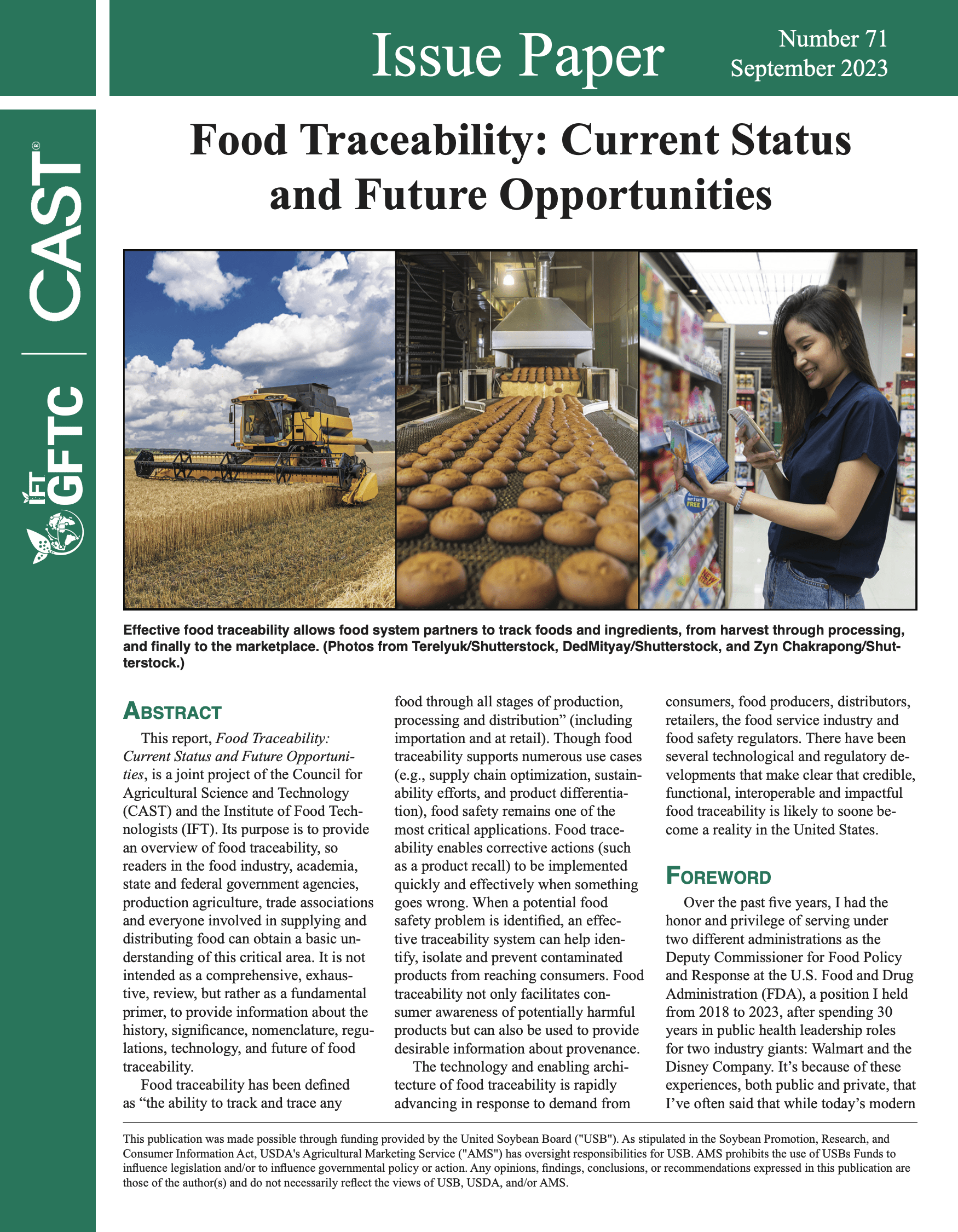
Food traceability has been defined as “the ability to track and trace any food through all stages of production, processing and distribution” (including importation and at retail). Though food traceability supports numerous use cases (e.g., supply chain optimization, sustainability efforts, and product differentiation), food safety remains one of the most critical applications. Food traceability enables corrective actions (such as a product recall) to be implemented quickly and effectively when something goes wrong. When a potential food safety problem is identified, an effective traceability system can help isolate and prevent contaminated products from reaching consumers. Food traceability not only facilitates consumer awareness of potentially harmful products but can also be used to provide desirable information about provenance.
The technology and enabling architecture of food traceability is rapidly advancing in response to demand from consumers, food producers, distributors and retailers, and food safety regulators. There have been several technological and regulatory developments that make clear that credible, functional, and impactful food traceability is likely to become a reality in the United States.
Food traceability has become an important focus in both industry and government. The incidence of food borne transmission of pathogens resulting in acute and long-term adverse health impacts remains stubbornly above acceptable levels.
- The primary objective of the paper is to investigate and discuss the development and use of various technologies to enable the traceability of food products and thus enhance food safety, source transparency, and consumer confidence.
- The paper will deep dive into the technological infrastructure underlying food traceability platforms, and discuss the history of such platforms, current state of the technology, ongoing U.S. food traceability regulatory initiatives, and the likelihood of commercial scale deployment.
- This paper will also address current infrastructure limitations that may slow technology implementation, including the current state of rural broadband access.
This publication is a joint effort between CAST (Council for Agricultural Science and Technology) and IFT (Institute of Food Technologists).
Downloads
References
Badia-Melis, R., P. Mishra, and L. Ruiz-Garcia. Food Traceability: New Trends and Recent Advances. A Review. Food Control 57(11):393–401.
Barton Behravesh, C., R. K. Mody, J. Jungk, L. Gaul, J. T. Redd, S. Chen, S. Cosgrove, E. Hedican, D. Sweat, L. Chávez-Hauser, S. L. Snow, H. Hanson, T.-A. Nguyen, S. V. Sodha, A. L. Boore, E. Russo, M. Mikoleit, L. Theobald, P. Gerner-Smidt, R. M. Hoekstra, F. J. Angulo, D. L. Swerdlow, R. V. Tauxe, P. M. Griffin, and I. T. Williams. 2011. 2008 Outbreak of Salmonella Saintpaul Infections Associated with Raw Produce. New England Journal of Medicine 364(10):918–927.
Bhatt, T., G. Buckley, J. C. McEntire, P. Lothian, B. Sterling, and C. Hickey. 2013. Making Traceability Work across the Entire Food Supply Chain. Journal of Food Science 78:B21–B27.
Blancou, J. 2001. A history of the traceability of animals and animal products. Rev Sci Tech 20(2):413–425.
Boz, Z. 2021. Moving Food Processing to Industry 4.0 and Beyond. Food Technology Magazine 75(6).
Columbia Center on Sustainable Investments (CCSI). 2021. Handbook for SDG-Aligned Food Companies: Four Pillar Framework Standards.
Crandall, P. G., A. Mauromoustakos, C. A. O’Bryan, and K. C. Thompson. 2017. Impact of the Global Food Safety Initiative on Food Safety Worldwide. Journal of Food Protection 80(10):1613–1622.
Delen, D., B. C. Hardgrave, and R. Sharda. 2008. The Promise of RFID-based Sensors in the Perishables Supply Chain. Information Technology Research Institute.
European Commission. n.d. The Key Obligations of Food and Feed Business Operators.
European Commission. 2007. Food Traceability.
Fernandez, A. 2021. A Deeper Dive into Interoperability: Exploring the Flow of Data in the Seafood Supply Chain. Food Safety Magazine.
Finances Online. 2023. Number of Restaurants in the US 2022/2023: Statistics, Facts, and Trends.
Fisher, W. 2015. (Referenced in text discussing benefits of traceability systems.)
Food and Agriculture Organization of the United Nations (FAO). 2022a. Publication (Rome).
Food and Agriculture Organization of the United Nations (FAO). 2022b. The State of World Fisheries and Aquaculture 2022.
Foodcircle. n.d. IoTs in Food Manufacturing.
Gemba. 2020. How Walmart used blockchain to increase supply chain transparency.
Gladek, E., M. Fraser, G. Roemers, O. Sabag Muñoz, E. Kennedy, P. Hirsch. 2017. The Global Food System: An Analysis. WWF Netherlands.
Global Dialogue on Seafood Traceability (GDST). 2020a. KDEs and CTEs for Wild-Caught Seafood.
Global Dialogue on Seafood Traceability (GDST). 2020b. Launch of new traceability standards.
Golan, E., B. Krissoff, F. Kuchler, L. Calvin, K. Nelson, and G. Price. Traceability of the U.S. Food Supply: Economic Theory and Industry Studies. Ag Economic Report 830.
Government of Canada. 2023. Fact sheet: Traceability.
GS1 US. 2018. Case Study: IPC/Subway.
GS1 US. 2021. Foodservice GS1 US Standards Initiative.
GS1 US. 2023. Foodservice GS1 US Standards Initiative Members.
Hassoun, A., et al. 2022. Consumer acceptance of new food trends resulting from fourth industrial revolution technologies. Frontiers in Nutrition 9:972154.
Hirst, K. K. 2019. Indus Seals and the Indus Civilization Script. ThoughtCo.
Institute of Food Technologists (IFT) Global Food Traceability Center. 2022. Vulnerability Traceability Implementation.
Institute of Food Technologists (IFT). 2023. Tech-Enabled Traceability Insights Based on FDA’s Low- or No-Cost Traceability Challenge.
Institute of Food Technologists Global Food Traceability Center (IFT GFTC). 2011. Product Tracing in Food Systems.
Institute of Food Technologists Global Food Traceability Center (IFT GFTC). 2016. Food Traceability 101 Training Program.
International Dairy Deli Bakery Association (IDDBA). 2013. Food Traceability Industry Initiatives.
International Fresh Produce Association (IFPA). 2023. History of Produce Safety.
International Organization for Standardization (ISO). 1994. Quality Management and Quality Assurance Vocabulary (ISO 8402).
International Organization for Standardization (ISO). 2015. Internet of Things Preliminary Report.
Ketchum Manufacturing Company. 2017. A Brief History of Animal Tags.
Kobiruzzaman, M. M. 2022. Technology Adoption Theories and Models Examples.
Kresin, J. M. 2019. Food safety forces change. The Packer.
Landais, E. 2001. The marking of livestock in traditional pastoral societies. Rev Sci Tech 20(2):445–479.
Mark, J. J. 2015. (Historical reference cited in literature list.)
Mejia, et al. 2010a. (Referenced regarding CTEs and KDEs terminology.)
Newsome, Bhatt, and McEntire. 2013. Traceability Improvement Initiative projections.
Philpot. 2021. Average cost of a product recall estimate.
Thesmar. 2015. Inventory control and traceability information access.
Traasdahl, A. 2020. How a History of Slow Technology Adoption Across Food Supply Chains Nearly Broke Us. Food Safety Tech.
United Nations Economic Commission for Europe (UNECE). Implementation Guide E-Certification SPS.
USDA APHIS. 2020. Animal Identification.
USDA ERS. 2019–2023. Retail trends, farming and farm income, and ag and food sectors and the economy.
Vietnamnet. 2020. QR codes fail to meet expectations.
Walaszczyk, A., and B. Galinska. 2020. Food origin traceability from a consumer’s perspective. Sustainability 12(5):1872.
Weightman, G. 2015. The History of the Barcode. Smithsonian Magazine.
Whittenberger, K., and E. Dohlman. 2010. Peanut Outlook: Impacts of the 2008–09 Foodborne Illness Outbreak Linked to Salmonella in Peanuts. USDA ERS.
World Economic Forum. 2019. A Brief History of Globalization.
World Wide Web Consortium (W3C). 2022. Decentralized Identifiers (DIDs) v1.0.
Zhang, J., and T. Bhatt. 2014. Best practices in food traceability. Comprehensive Reviews in Food Science and Food Safety 13(5):1074–1103.
Zuo, J., et al. 2022. RFID-based sensing in smart packaging for food applications: A review. Future Foods 6:100198.
Downloads
Published
Issue
Section
License
Copyright (c) 2026 Council for Agricultural Science and Technology (CAST)

This work is licensed under a Creative Commons Attribution-NonCommercial 4.0 International License.
License Terms for CC Attribution-NonCommercial 4.0:
License URL: https://creativecommons.org/licenses/by-nc/4.0/
License Terms Statement:
You are free to:
- Share — copy and redistribute the material in any medium or format
- Adapt — remix, transform, and build upon the material
Under the following conditions:
- Attribution — you must give appropriate credit, provide a link to the license, and indicate if changes were made
- NonCommercial — you may not use the material for commercial purposes
No additional restrictions — you may not apply legal terms or technological measures that legally restrict others from doing anything the license permits.