
Impacto del Principio Precautorio en la Alimentación de las Generaciones Actuales y Futuras
DOI:
https://doi.org/10.62300/eh2vts23Keywords:
Principio Precautorio, Gestión de riesgos, Innovación tecnológica agrícola, Biotecnología y alimentos GM, Seguridad alimentariaAbstract
Este documento analiza críticamente el Principio Precautorio (PP) y su creciente influencia en las políticas relacionadas con los alimentos y la agricultura. Aunque el PP surgió como una herramienta destinada a proteger la salud humana y el ambiente ante la incertidumbre científica, los autores muestran que, en la práctica, su ambigüedad, falta de criterios claros y aplicación arbitraria lo han convertido en un obstáculo para la innovación y la seguridad alimentaria. Mediante estudios de caso sobre agroquímicos, alimentos modificados genéticamente e irradiación de alimentos, el informe evidencia que una aplicación estricta del PP puede generar más riesgos de los que previene: limita tecnologías más seguras que sus predecesoras, frena el desarrollo agrícola, afecta el comercio internacional y retrasa la adopción de innovaciones esenciales para enfrentar el aumento proyectado en la demanda global de alimentos.
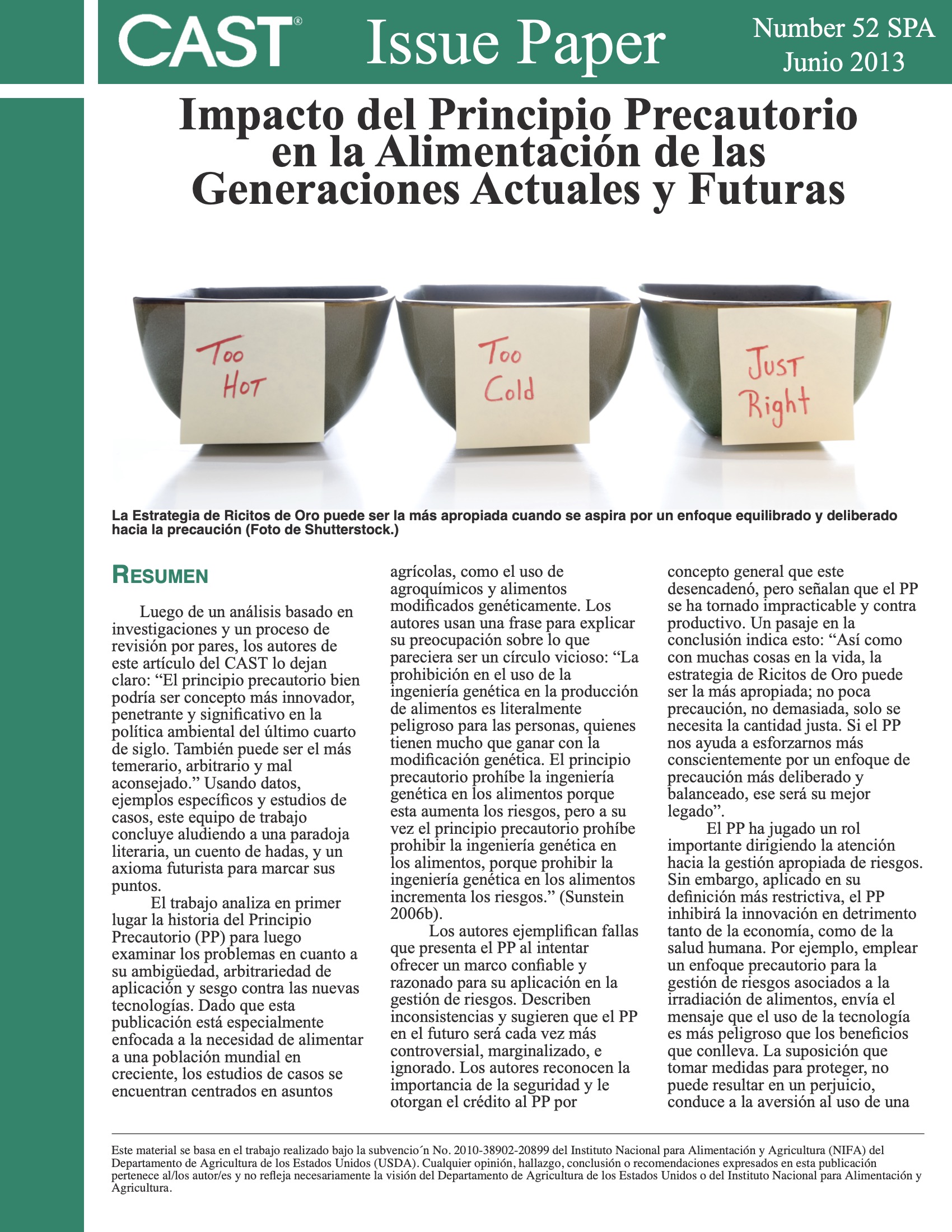
Los autores destacan que la aplicación selectiva y politizada del PP ha impedido la difusión de cultivos con beneficios comprobados —como el arroz dorado o la berenjena Bt— y obstaculiza tecnologías que podrían reducir enfermedades transmitidas por alimentos, aumentar la productividad agrícola y mejorar la nutrición mundial. Concluyen que el PP, tal como se utiliza actualmente, no ofrece una base racional para la gestión de riesgos y, en muchos casos, produce efectos contraproducentes para la salud pública, el ambiente y el desarrollo económico. En su lugar, proponen una estrategia equilibrada —la “estrategia de Ricitos de Oro”— que aplique la cantidad justa de precaución, basada en evidencia científica y en un análisis proporcional de riesgos y beneficios.
Downloads
References
Adenle, A.A., O. C. Aworh, R. Akromah, and G. Parayil. 2012. Developing GM super cassava for improved health and food security: Future challenges in Africa. Agr Food Sec 1:1–15.
Applegate, J. 2000. Precautionary preference: An American perspective on the precautionary principle. Hum Ecol Risk Assess 6 (3): 413–443.
Ashford, N.A. 2005. Implementing the precautionary principle: Incorporating science, technology, fairness, and accountability in environmental, health and safety decisions. Int J Risk Assess Manage 5:112–124.
Ashford, N.A. 2007. The legacy of the precautionary principle in U.S. law: The rise of cost-benefit analysis and risk assessment as undermining factors in health, safety and environmental protection. In N. de Sadeleer (ed.). Implementing the Precautionary Principle: Approaches from the Nordic Countries, the EU and the United States. Earthscan, London.
Batista, R., N. Saibo, T. Lourenco, and M. M. Oliveira. 2008. Microarray analyses reveal that plant mutagenesis may induce more transcriptomic changes than transgene insertion. P Natl Acad Sci 105 (9): 3640–3645.
Beck, U. 1992. Risk Society: Towards a New Modernity. Sage Publications Limited, London.
Beyer, P., S. Al-Babili, X. Ye, P. Lucca, P. Schaub, R. Welsch, and I. Potrykus. 2002. Golden rice: Introducing the β-carotene biosynthesis pathway into rice endosperm by genetic engineering to defeat vitamin A deficiency. J Nutr 132 (3): 506S–510S.
Bodansky, D. 1991. Scientific uncertainty and the precautionary principle. Environment 33 (7): 4–5.
Bohannon, J. 2002. Zambia rejects GM corn on scientists’ advice. Science 298:1153.
Bradford, K. J., A.V. Deynze, N. Gutterson, W. Parrott, and S. H. Strauss. 2005. Regulating transgenic crops sensibly: Lessons from plant breeding, biotechnology and genomics. Nat Biotechnol 23 (4): 439–444.
Brock, W. J., J.V. Rodricks, A. Rulis, V. L. Dellarco, G. M. Gray, and R.W. Lane. 2003. Food safety: Risk assessment and decision-making criteria. Int J Toxicol 22:435–451.
Byrne, D. 2004. “The Regulation of Food Safety and the Use of Traceability/Tracing in the EU and USA: Convergence or Divergence?” Speech to Food Safety Conference, Washington, D.C., March 19, 2004.
Carpenter, J. 2010. Peer-reviewed surveys indicate positive impact of commercialized GM. Nat Biotechnol 28 (4): 319–321.
Chapman, P. M. 1999. Risk assessment and the precautionary principle: A time and a place. Mar Pollut Bull 38:944–947.
Codex Alimentarius Commission. 1983. Codex General Standard for Irradiated Food and Recommended International Code of Practice for the Operation of Irradiation Facilities Used for the Treatment of Foods. Vol. 15. FAO/WHO, Rome (rev. 2003).
Commission of the European Communities. 2000. Communication from the Commission on the Precautionary Principle. Brussels, COM(2000)1.
Commission of the European Communities. 2004. Communication from the Commission: Towards a European Strategy for Nanotechnology. Brussels, COM(2004)338 final.
Commission v. Denmark, Case C-192/01 (Advocate General 2003).
Commission v. France, Case C-24/00 (ECJ 2004).
Committee on World Food Security (CFS). 2012. Global Strategic Framework for Food Security and Nutrition.
Convention on Biological Diversity. 2000. Cartagena Protocol on Biosafety.
Cranor, C. 2004. Toward understanding aspects of the precautionary principle. J Med Philos 29:259–279.
Crichton, M. 2004. State of Fear. Harper Collins, New York.
EFTA Surveillance Authority v. Norway, Case E-3/00 (2001).
ENDS Europe. 2000. “Opinion divided on EU precaution paper.”
European Community (EC). 1999. Directive 1999/3/EC on ionizing radiation of foods.
European Court of Justice (ECJ). 2012. Pioneer Hi-Bred Italia Srl v. Ministero delle Politiche agricole.
European Union. 2001. Proposal for Council Regulation on State Aid to the Coal Industry.
Falkner, R. 2007. The global biotech food fight: Why the U.S. got it so wrong. Brown J World Affairs XI(1): 99–110.
Farrow, S. 2004. Using risk assessment, benefit–cost analysis, and real options to implement a precautionary principle. Risk Anal 24:727–735.
Fedoroff, N.V. 1989. Maize transposable elements in development and evolution. Am Zool 29:549–555.
Finger, R., N. El Benni, T. Kaphengst, C. Evans, S. Herbert, B. Lehmann, S. Morse, and N. Stupak. 2011. A meta-analysis on farm-level costs and benefits of GM crops. Sustainability 3 (3): 743–762.
FAO. 2009. Global agriculture towards 2050.
Foster, K. R., P. Vecchia, and H. Repacholi. 2000. Science and the precautionary principle. Science 288:979–980.
Frank, T., R. M. Rohlig, H. V. Davies, E. Barros, and K-H. Engel. 2012. Metabolite profiling of maize kernels—Genetic modification vs environmental influence. J Agric Food Chem 60:3005–3012.
Freestone, D., and E. Hey. 1996. The Precautionary Principle and International Law. Kluwer Law International.
Fumento, M. 1994. “To save lives with safer food.” Washington Times.
Gallager, D., and A. Kwittken. 1994. Meat inspection system “insufficient.” AGA Foundation.
Global Harvest Initiative. 2012. GAP Report: Measuring Global Agricultural Productivity.
Godfrey, H. C. J., et al. 2010. The future of the global food system. Philos Trans R Soc B 365:2769–2777.
Goklany, I. M. 2001. Precaution without perversity: Application of the PP to GM crops. Biotechnol Law Rep 20:377–396.
Goldstein, B. D., and R. S. Carruth. 2004. Implications of the PP: A threat to science? Int J Occup Med Env 17:153–161.
Graham, J. 2002. Speech by OMB Regulatory Chief John Graham on precautionary principle.
McGinnis, E. E., M. H. Meyer, and A. G. Smith. 2012. U.S. GE crop regulation. Crop Sci 52 (3): 991–1002.
McHughen, A., and S. Smyth. 2008. U.S. regulatory system for GM crops. Plant Biotechnol J 6:2–12.
Miller, H. I., and G. Conko. 2001. Precaution without principle. Nat Biotechnol 19:302–303.
Morris, J. 2002. Risk analysis and the PP. Toxicology 181–182:127–130.
Morris, S. H. 2007. EU biotech crop regulations. Trends Biotechnol 25 (1): 2–6.
Oerke, E-C., and H-W. Dehne. 1997. Global crop production and crop protection. Eur J Plant Pathol 103:203–215.
OMB/OSTP. 2007. Updated Principles for Risk Analysis.
OSTP. 1986. Coordinated Framework for Regulation of Biotechnology.
Padmanaban, G. 2009. Bt brinjal—Ban or boon? Curr Sci 97 (12):1715–1716.
Park, J., I. McFarlane, R. Phipps, and G. Ceddia. 2011. Impact of EU GM regulatory constraints on farm income. New Biotechnol 28 (4):396–406.
Partridge, M., and D. J. Murphy. 2004. Detection of GM soya in organic products. Brit Food J 106 (3):166–180.
Pauly, C., and C. Schult. 2013. Trans-Atlantic trade rifts. Spiegel Online.
Pew Initiative on Food and Biotechnology. 2004. Issues in the Regulation of GE Plants and Animals.
Pingali, P. L., and G. Traxler. 2002. Will the poor benefit from biotech? Food Policy 27:223–238.
Potrykus, I. 2010. Lessons from Golden Rice: Regulation prevents public-good GM crops. New Biotechnol 27 (5):466–472.
Qaim, M. 2009. Economics of GM crops. Annu Rev Res Econ 1:665–693.
Raffensperger, C., and P. L. deFur. 1999. Implementing the PP. Hum Ecol Risk Assess 5:933–941.
Raney, T. 2006. Economic impact of GM crops in developing countries. Curr Opin Biotechnol 17:1–5.
Ricroch, A. E., J. B. Berge, and M. Kuntz. 2011. Evaluation of GM crops using omics profiling. Plant Physiol 155:1752–1761.
Ronald, P. 2011. Plant genetics, sustainable agriculture, and food security. Genetics 188:11–20.
Sandin, P. 1999. Dimensions of the PP. Hum Ecol Risk Assess 5:889–907.
Sandin, P., and S. O. Hansson. 2002. The default value approach to the PP. Hum Ecol Risk Assess 8 (3):463–471.
Santillo, D., et al. 1998. The PP and scientific method. Mar Pollut Bull 36 (12):939–950.
Seifert, F. 2011. Sustainability and agribiotech controversy. Int J Technol Dev Studies 2 (1):2–29.
Seufert, V., N. Ramankutty, and J. A. Foley. 2012. Comparing organic and conventional yields. Nature 485:229–232.
Shelton, A. M. 2010. Commercialization of Bt brinjal in India. Crop Prot 29:412–414.
Slovic, P. 1987. Perception of risk. Science 236:280–285.
Spielman, D. J. 2007. Pro-poor agricultural biotechnology. Food Policy 32:189–204.
Starr, C. 2003. The PP vs risk analysis. Risk Anal 23 (1):1–3.
Stokes, E. 2008. EC courts refine precautionary parameters. J Risk Res 11:491–507.
Sunstein, C. R. 2003. Beyond the PP. Univ. of Chicago Public Law Paper No. 38.
Sunstein, C. R. 2004. Safe and sorry. Forbes 173 (14):48.
Sunstein, C. R. 2005. Laws of Fear: Beyond the PP. Cambridge Univ. Press.
Sunstein, C. R. 2006a. Irreversible and catastrophic harms. Cornell Law Rev 91:841–897.
Sunstein, C. R. 2006b. Irreversible and catastrophic. Pace Environ Law Rev 23:3–19.
Taub, I. A. 1984. Free radical reactions in food. J Chem Educ 61:313–324.
Trouwborst, A. 2007. PP in international law. RECIEL 16 (2):185–195.
United Kingdom House of Commons Science and Technology Committee. 2006. Scientific Advice, Risk and Evidence-Based Policy Making.
UNCED. 1992. Rio Declaration on Environment and Development.
United Nations General Assembly. 1982. World Charter for Nature.
Urbain, W. M. 1986. Food Irradiation. Academic Press.
USEPA. 2008. Implementing the Pesticide Registration Improvement Act.
USEPA. 2011. Estimating Data Generation Costs for a New Pesticide Active Ingredient.
USEPA. 2012a. Accomplishments under the FQPA.
USEPA. 2012b. America’s Children and the Environment.
USEPA. 2012c. Pesticide Reregistration Performance Measures.
USEPA. 2012d. Sulfuryl fluoride proposed order.
USEPA. 2012e. FQPA accomplishments.
Vinocur, B., and A. Altman. 2005. Engineering plant tolerance to abiotic stress. Curr Opin Biotechnol 16:123–132.
Wang, W., B. Vinocur, and A. Altman. 2003. Plant responses to drought, salinity, and extreme temperatures. Planta 218:1–14.
Wang, Z-Y., and E. C. Brummer. 2012. Will genetic engineering take off in forages? Ann Bot.
Weed, D. L. 2002. Is the PP a principle? IEEE Technol Soc Mag 21 (4):45–48.
Weiss, C. 2003. Scientific uncertainty and PP. Int Environ Agreements 3:137–166.
Wiedemann, P. M., and H. Schütz. 2005. PP and risk perception. Environ Health Perspect 113:402–405.
Wiener, J. B. 2002. PP in a multirisk world. In Paustenbach (ed.) Human and Ecological Risk Assessment.
Wiener, J. B., and M. D. Rogers. 2002. Comparing precaution in U.S. and Europe. J Risk Res 5 (4):317–349.
WHO. 1966. Technical Basis for Legislation on Irradiated Food.
WHO. 1981. Wholesomeness of Irradiated Food.
WHO. 1994. Safety and Nutritional Adequacy of Irradiated Food.
WTO. 2006. EC Measures Affecting Biotech Products. Panel Report WT/DS291.
Downloads
Published
Issue
Section
License
Copyright (c) 2020 Council for Agricultural Science and Technology (CAST)

This work is licensed under a Creative Commons Attribution-NonCommercial 4.0 International License.
License Terms for CC Attribution-NonCommercial 4.0:
License URL: https://creativecommons.org/licenses/by-nc/4.0/
License Terms Statement:
You are free to:
- Share — copy and redistribute the material in any medium or format
- Adapt — remix, transform, and build upon the material
Under the following conditions:
- Attribution — you must give appropriate credit, provide a link to the license, and indicate if changes were made
- NonCommercial — you may not use the material for commercial purposes
No additional restrictions — you may not apply legal terms or technological measures that legally restrict others from doing anything the license permits.