
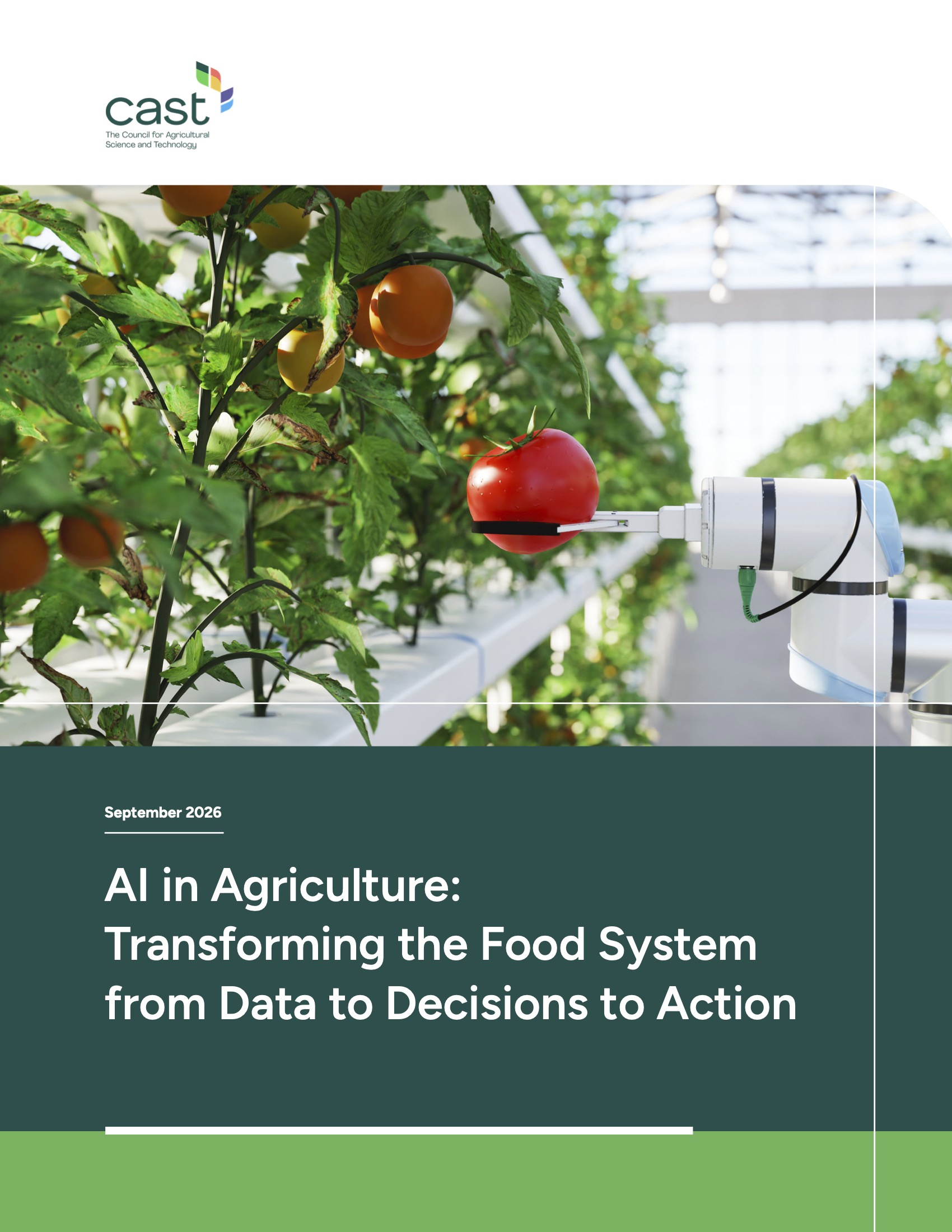
AI in Agriculture: Transforming the Food System from Data to Decisions to Action
DOI:
https://doi.org/10.62300/f5ts2461Keywords:
Artificial intelligence, Precision agriculture, Agricultural policy, Autonomous systems, Food systemsAbstract
Artificial intelligence is rapidly becoming a foundational technology across the U.S. food system — embedded in field equipment, production systems, food processing, supply chains, and natural resource management. Unlike earlier precision agriculture tools that collected and displayed data for human review, AI now interprets complex conditions, recommends management strategies, and, through robotics and autonomous equipment, performs physical tasks that once required human presence. This paper examines that transition across the full agricultural value chain and considers its implications for research, governance, and policy.
The paper reviews AI applications in crop and livestock production, food and postharvest systems, and natural resource management, documenting a shift from reactive to predictive and autonomous operations. It introduces the concept of physical AI — systems that perceive, reason, and act under biological variability and environmental uncertainty — and identifies agriculture as one of its most demanding proving grounds. Generative AI is examined separately as a force democratizing access to advanced analytics across farm sizes and technical backgrounds.
The paper argues that the binding constraints on responsible AI adoption are not primarily technical but institutional: data quality and representativeness, rigorous field validation, transparency in how recommendations are generated, and cybersecurity and interoperability across systems. Five policy areas receive sustained attention — agricultural data as national research infrastructure, the resource tradeoffs of rural AI infrastructure, competition and producer choice in integrated digital platforms, workforce preparation at every level of the food system, and the regulatory challenges of increasingly autonomous agricultural systems. The paper concludes that policy choices made in the near term will significantly shape both the pace and equity of AI adoption across U.S. agriculture.
Downloads
Downloads
Additional Files
Published
Issue
Section
License
Copyright (c) 2026 Council for Agricultural Science and Technology (CAST)

This work is licensed under a Creative Commons Attribution-NonCommercial 4.0 International License.
License Terms for CC Attribution-NonCommercial 4.0:
License URL: https://creativecommons.org/licenses/by-nc/4.0/
License Terms Statement:
You are free to:
- Share — copy and redistribute the material in any medium or format
- Adapt — remix, transform, and build upon the material
Under the following conditions:
- Attribution — you must give appropriate credit, provide a link to the license, and indicate if changes were made
- NonCommercial — you may not use the material for commercial purposes
No additional restrictions — you may not apply legal terms or technological measures that legally restrict others from doing anything the license permits.