
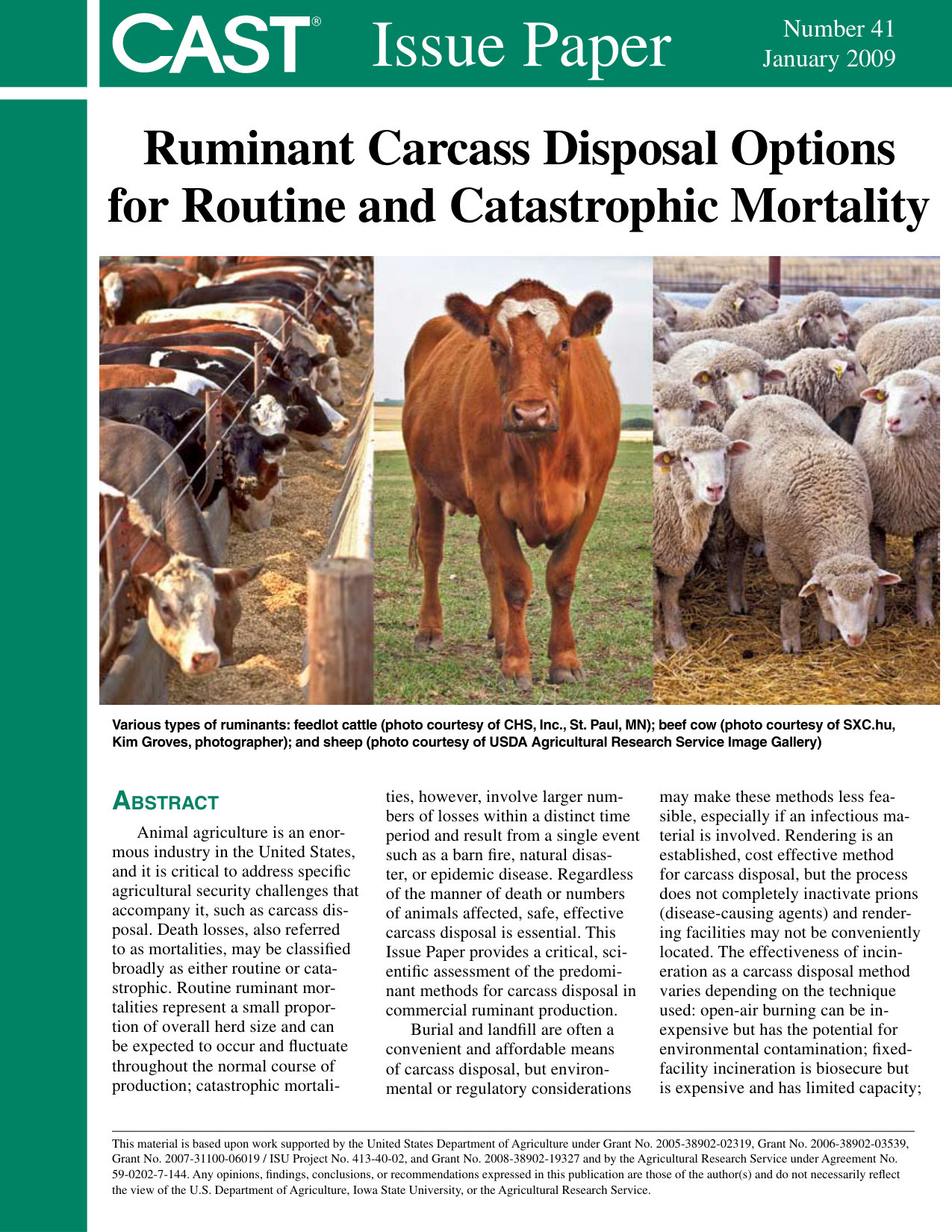
Ruminant Carcass Disposal Options for Routine and Catastrophic Mortality
DOI:
https://doi.org/10.62300/3df04q45Keywords:
Ruminant Carcass Disposal, Catastrophic Mortality, Commercial Ruminant ProductionAbstract
When producers decide which carcass disposal method to use, they must consider the number of mortalities, the cause of death and whether infectious agents are involved, environmental implications, regulatory requirements, operational costs, and efficiency. This Issue Paper provides a comprehensive summary of the scientific, technical, and social aspects of various ruminant carcass disposal technologies using information gleaned from a Kansas State University comprehensive report. The authors discuss the predominant methods of mortality disposal in commercial ruminant production, including burial and landfill, rendering, composting, incineration, and alkaline hydrolysis. The paper includes an Appendix that addresses special considerations for material potentially infected with diseases.Downloads
Download data is not yet available.
References
Downloads
Published
2009-01-05
Issue
Section
Issue Papers
License
Copyright (c) 2009 Council for Agricultural Science and Technology (CAST)

This work is licensed under a Creative Commons Attribution-NonCommercial 4.0 International License.
License Terms for CC Attribution-NonCommercial 4.0:
License URL: https://creativecommons.org/licenses/by-nc/4.0/
License Terms Statement:
You are free to:
- Share — copy and redistribute the material in any medium or format
- Adapt — remix, transform, and build upon the material
Under the following conditions:
- Attribution — you must give appropriate credit, provide a link to the license, and indicate if changes were made
- NonCommercial — you may not use the material for commercial purposes
No additional restrictions — you may not apply legal terms or technological measures that legally restrict others from doing anything the license permits.
How to Cite
Vanier, M., Comer, P. J., Hater, G., Kaye, G. I., Meeker, D. L., & Thacker, H. L. (2009). Ruminant Carcass Disposal Options for Routine and Catastrophic Mortality. Council for Agricultural Science and Technology (CAST). https://doi.org/10.62300/3df04q45