
Protecting Food Animal Gene Pools for Future Generations
DOI:
https://doi.org/10.62300/6t1ct421Keywords:
Animal Gene Pool, Agricultural Productivity, Genetic DiversityAbstract
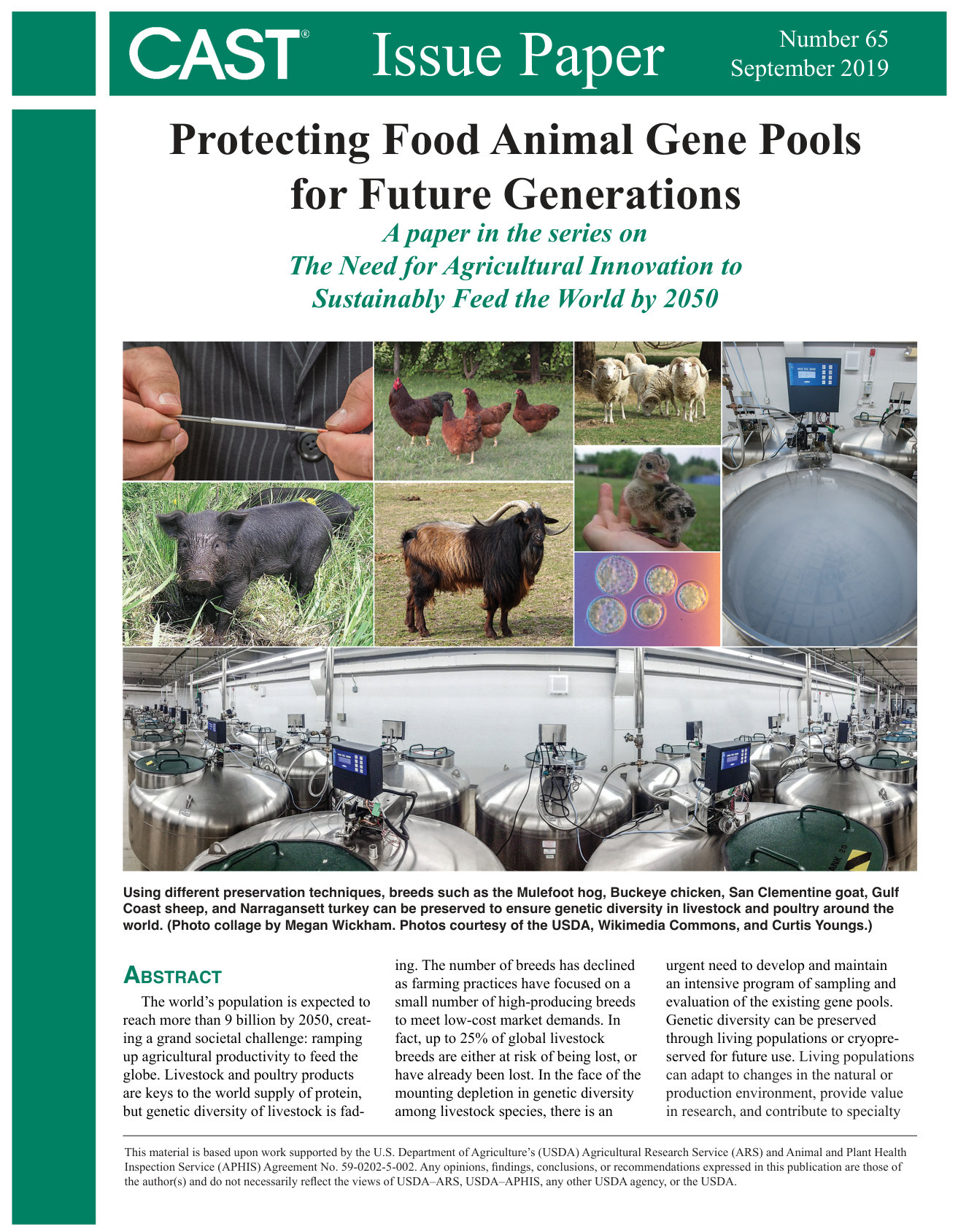
The world’s population is expected to reach more than 9 billion by 2050, creating a grand societal challenge: ramping up agricultural productivity to feed the globe. Livestock and poultry products are keys to the world supply of protein, but genetic diversity of livestock is fading. The number of breeds has declined as farming practices have focused on a narrow number of high-producing breeds to meet low-cost market demands. In fact, up to 30% of global livestock breeds are currently at risk and, if lost, cannot be replaced. In the face of the mounting depletion in genetic diversity among livestock species, there is an urgent need to develop and maintain an intensive program of sampling and evaluation of the existing gene pools. Genetic diversity can be preserved through living populations or cryopreserved for future use. Living populations can adapt to changes in the natural or production environment, provide value in research, and contribute to specialty markets. Cryopreservation offers rare and major breeds a benefit—whether to reconstitute lost bloodlines or to serve as a safety net in case of catastrophic loss of a diminished population. This paper addresses several important challenges regarding the effective protection of remaining genetic diversity: 1) characterizing the animal populations to identify unique attributes that will influence the collection and conservation of breeds; 2) improving cryopreservation technology for a variety of germplasm and cell types that targets biological differences impeding success among species; 3) expanding the content, accessibility and cross-talk among databases housing breed and genetic resource information; and 4) developing private-public partnerships among rare breed associations/curators, agricultural universities, federal agencies and non-governmental organizations to ensure the long-term operational continuity of germplasm repositories.Downloads
Download data is not yet available.
Downloads
Published
2019-09-30
Issue
Section
Issue Papers
License
Copyright (c) 2019 Council for Agricultural Science and Technology (CAST)

This work is licensed under a Creative Commons Attribution-NonCommercial 4.0 International License.
License Terms for CC Attribution-NonCommercial 4.0:
License URL: https://creativecommons.org/licenses/by-nc/4.0/
License Terms Statement:
You are free to:
- Share — copy and redistribute the material in any medium or format
- Adapt — remix, transform, and build upon the material
Under the following conditions:
- Attribution — you must give appropriate credit, provide a link to the license, and indicate if changes were made
- NonCommercial — you may not use the material for commercial purposes
No additional restrictions — you may not apply legal terms or technological measures that legally restrict others from doing anything the license permits.
How to Cite
Long, J. A., Blackburn, H., Martin, A., Robert L. Taylor, J., Silversides, F., & Youngs, C. R. (2019). Protecting Food Animal Gene Pools for Future Generations. Council for Agricultural Science and Technology (CAST). https://doi.org/10.62300/6t1ct421