
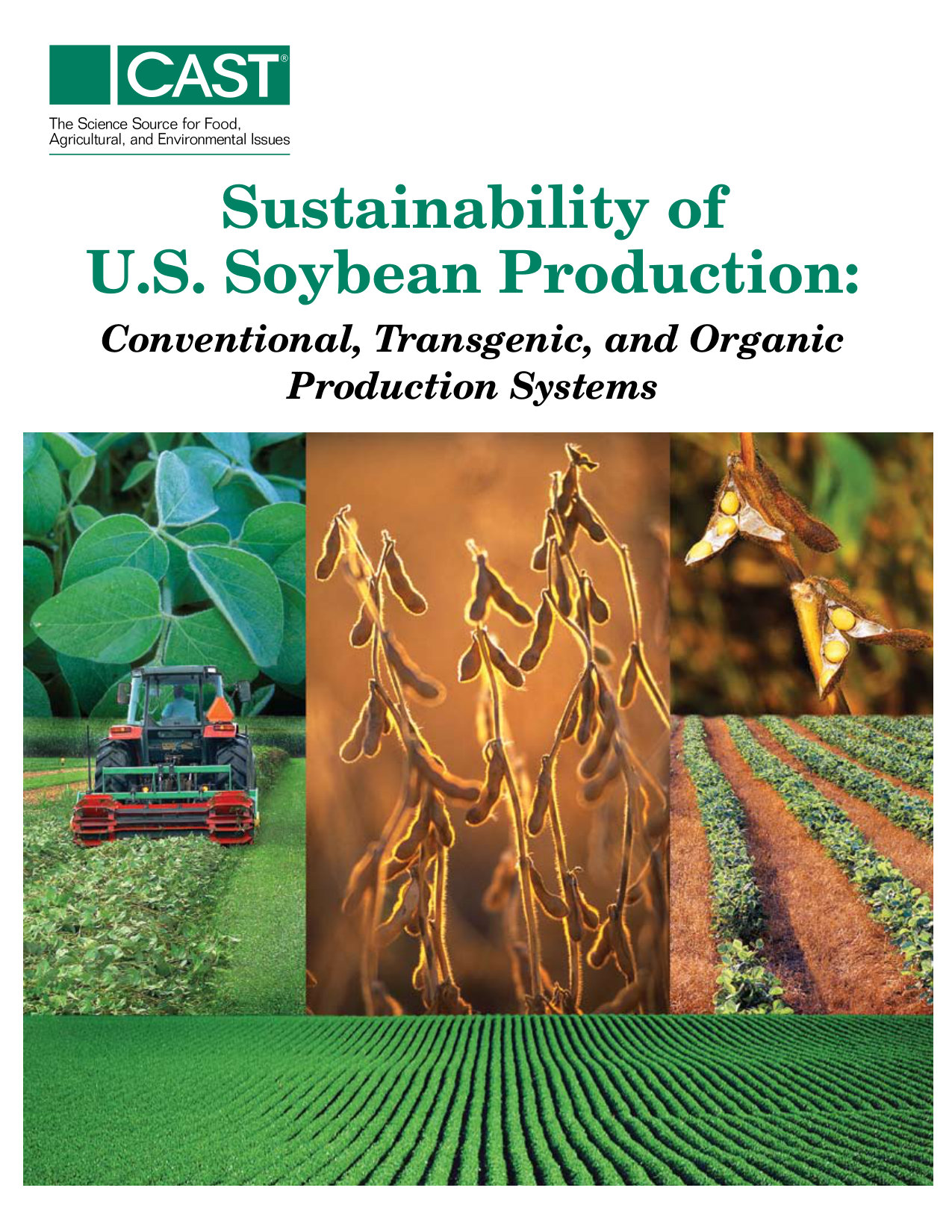
Sustainability of U.S. Soybean Production: Conventional, Transgenic, and Organic Production Systems
DOI:
https://doi.org/10.62300/bjddb581Keywords:
Soybean Production, Sustainability, Human Consumption, CropAbstract
This CAST Special Publication documents the ecological and economic implications of the various systems used in U.S. soybean production. Soybean production has changed in the United States since its first introduction in the mid-1880s. Initially, the crop was produced mainly for forage and received only minimal inputs. Today, soybeans have become a major source of protein in animal diets and vegetable oils for human consumption. Considering this dramatic change, CAST is providing a comprehensive literature review that evaluates U.S. soybean production systems currently in use with respect to their environmental and economic sustainability.Downloads
Download data is not yet available.
Downloads
Published
2009-06-13
Issue
Section
Special Publications
License
Copyright (c) 2009 Council for Agricultural Science and Technology (CAST)

This work is licensed under a Creative Commons Attribution-NonCommercial 4.0 International License.
License Terms for CC Attribution-NonCommercial 4.0:
License URL: https://creativecommons.org/licenses/by-nc/4.0/
License Terms Statement:
You are free to:
- Share — copy and redistribute the material in any medium or format
- Adapt — remix, transform, and build upon the material
Under the following conditions:
- Attribution — you must give appropriate credit, provide a link to the license, and indicate if changes were made
- NonCommercial — you may not use the material for commercial purposes
No additional restrictions — you may not apply legal terms or technological measures that legally restrict others from doing anything the license permits.
How to Cite
Heatherly, L., Dorrance, A., Hoeft, R., Onstad, D., Orf, J., Porter, P., Spurlock, S., & Young, B. (2009). Sustainability of U.S. Soybean Production: Conventional, Transgenic, and Organic Production Systems. Council for Agricultural Science and Technology (CAST). https://doi.org/10.62300/bjddb581