
Food Loss and Waste
DOI:
https://doi.org/10.62300/s4reqa70Keywords:
Food Waste, Food Loss, Food SustainabilityAbstract
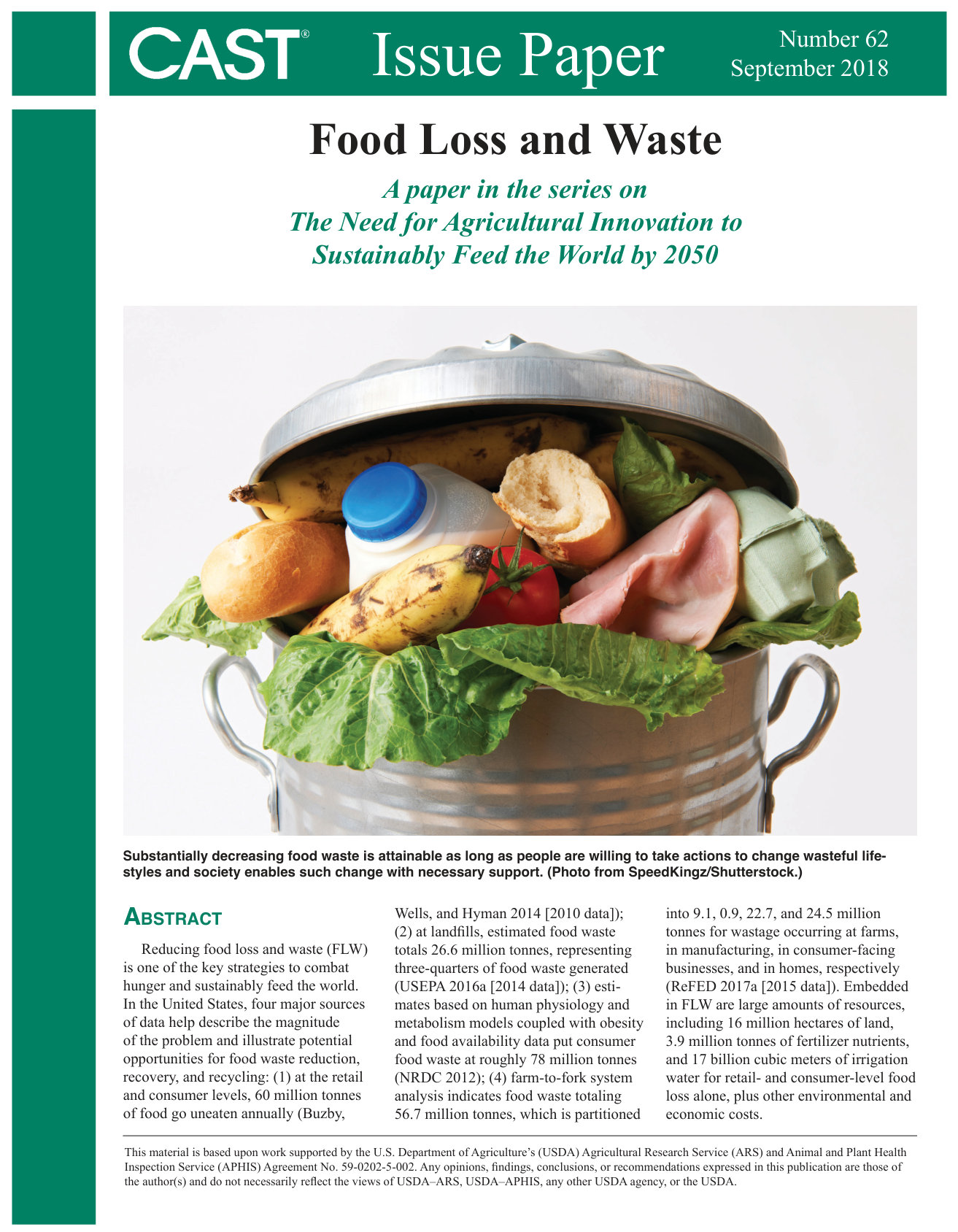
Reducing food loss and waste (FLW) is one of the key strategies to combat hunger and sustainably feed the world. In the United States, four major sources of data help describe the magnitude of the problem and illustrate potential opportunities for food waste reduction, recovery, and recycling: (1) at the retail and consumer levels, 60 million tonnes of food go uneaten annually (Buzby, Wells, and Hyman 2014 [2010 data]); (2) at landfills, estimated food waste totals 26.6 million tonnes, representing three-quarters of food waste generated (USEPA 2016a [2014 data]); (3) estimates based on human physiology and metabolism models coupled with obesity and food availability data put consumer food waste at roughly 78 million tonnes (NRDC 2012); (4) farm-to-fork system analysis indicates food waste totaling 56.7 million tonnes, which is partitioned into 9.1, 0.9, 22.7, and 24.5 million tonnes for wastage occurring at farms, in manufacturing, in consumer-facing businesses, and in homes, respectively (ReFED 2017a [2015 data]). Embedded in FLW are large amounts of resources, including 16 million hectares of land, 3.9 million tonnes of fertilizer nutrients, and 17 billion cubic meters of irrigation water for retail- and consumer-level food loss alone, plus other environmental and economic costs. Factors contributing to FLW vary depending on the stage or sectors of the food system. Market and human elements together with social and cultural forces interact to shape our relationship with food and influence our food behavior. Currently, citizens, organizations, businesses, and government agencies are undertaking a variety of food waste reduction efforts. It is estimated that annually in the United States, up to 2 million tonnes of food are rescued for humans, 15–16 million tonnes of food waste are recovered for animal feeding or other beneficial uses, and 7–8 million tonnes are recycled through composting. Of these amounts, roughly three-quarters (19 million tonnes) is achieved through FLW recovery or recycling at the manufacturing stage. Much work remains to substantially decrease FLW in the consumption stage involving consumer-facing businesses and homes. The following critical needs are identified. First, since much effort has focused on food-waste composting, it is important to quantitatively assess and crosscompare those composting programs for their efficacies, costs and benefits, lessons and barriers, and potential limitations. Such information is essential for the nation to design strategic policies and priorities while avoiding inefficient outcomes. Second, a potential game changer to resolve food waste generated at the consumption stage is the development and adoption of innovative technologies that could convert wasted food into safe and nutritious feed for livestock animals. This requires creative policies and mechanisms to foster technological innovation, enable entrepreneurship, and support relevant research. Third, understanding consumer food behavior in light of established theories in social, behavioral, and psychological sciences—coupled with action-based research—is critically needed for the purpose of exploring new and innovative behavior-changing interventions in order to complement existing awareness-raising campaigns for broader impacts. The phenomenon of FLW has many drivers and influencing factors. To decrease FLW at a meaningful scale requires all workable solutions.Downloads
Download data is not yet available.
Downloads
Published
2018-09-18
Issue
Section
Issue Papers
License
Copyright (c) 2018 Council for Agricultural Science and Technology (CAST)

This work is licensed under a Creative Commons Attribution-NonCommercial 4.0 International License.
License Terms for CC Attribution-NonCommercial 4.0:
License URL: https://creativecommons.org/licenses/by-nc/4.0/
License Terms Statement:
You are free to:
- Share — copy and redistribute the material in any medium or format
- Adapt — remix, transform, and build upon the material
Under the following conditions:
- Attribution — you must give appropriate credit, provide a link to the license, and indicate if changes were made
- NonCommercial — you may not use the material for commercial purposes
No additional restrictions — you may not apply legal terms or technological measures that legally restrict others from doing anything the license permits.
How to Cite
Dou, Z., Cochran, C., Finn, S. M., Galligan, D., Goldstein, N., & O'Donnell, T. (2018). Food Loss and Waste. Council for Agricultural Science and Technology (CAST). https://doi.org/10.62300/s4reqa70