
Genome Editing in Agriculture: Methods, Applications, and Governance
DOI:
https://doi.org/10.62300/9edp5j93Palabras clave:
Genome Editing, Food Engineering, GEResumen
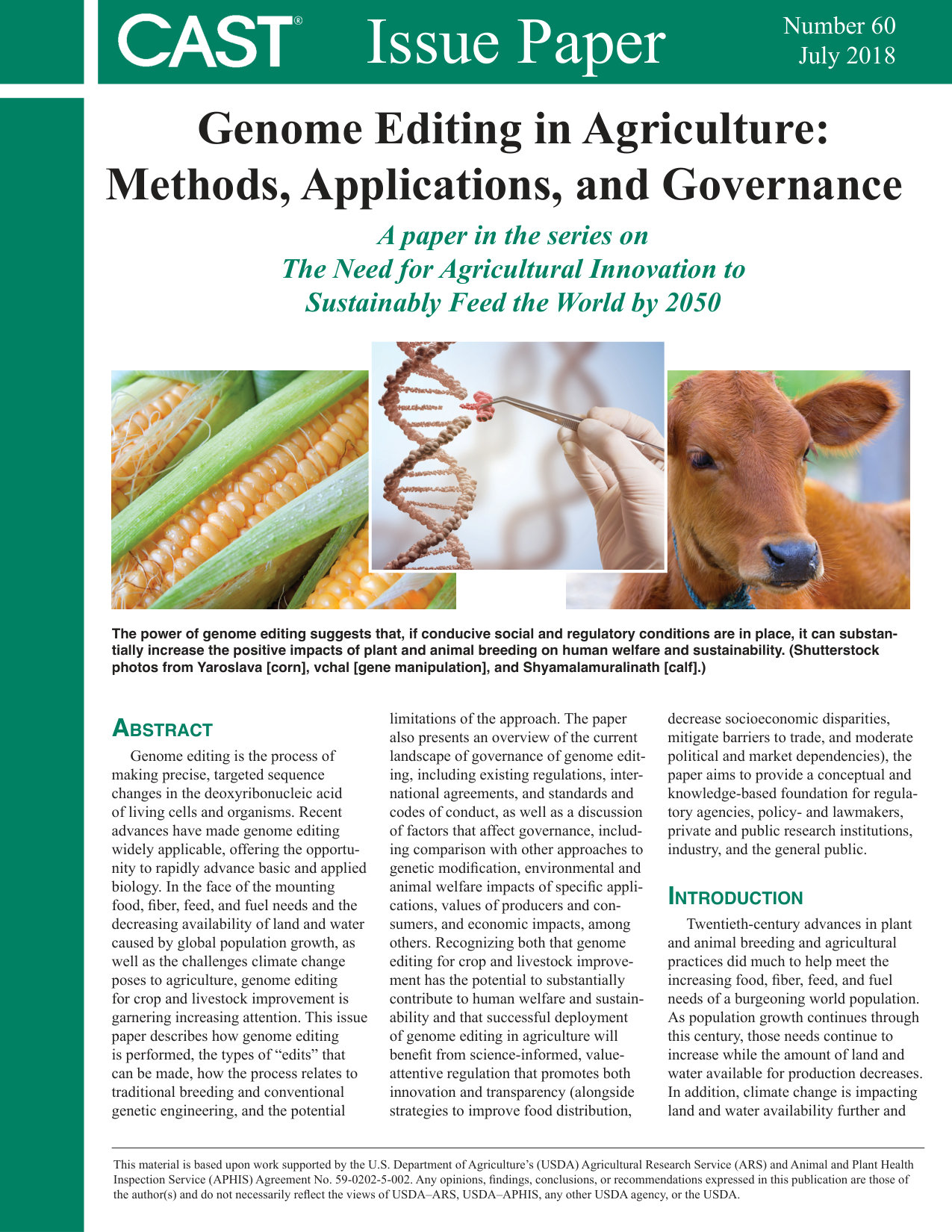
Genome editing is the process of making precise, targeted sequence changes in the deoxyribonucleic acid of living cells and organisms. Recent advances have made genome editing widely applicable, offering the opportunity to rapidly advance basic and applied biology. In the face of the mounting food, fiber, feed, and fuel needs and the decreasing availability of land and water caused by global population growth, as well as the challenges climate change poses to agriculture, genome editing for crop and livestock improvement is garnering increasing attention. This issue paper describes how genome editing is performed, the types of “edits” that can be made, how the process relates to traditional breeding and conventional genetic engineering, and the potential limitations of the approach. The paper also presents an overview of the current landscape of governance of genome editing, including existing regulations, international agreements, and standards and codes of conduct, as well as a discussion of factors that affect governance, including comparison with other approaches to genetic modification, environmental and animal welfare impacts of specific applications, values of producers and consumers, and economic impacts, among others. Recognizing both that genome editing for crop and livestock improvement has the potential to substantially contribute to human welfare and sustainability and that successful deployment of genome editing in agriculture will benefit from science-informed, valueattentive regulation that promotes both innovation and transparency (alongside strategies to improve food distribution, decrease socioeconomic disparities, mitigate barriers to trade, and moderate political and market dependencies), the paper aims to provide a conceptual and knowledge-based foundation for regulatory agencies, policy- and lawmakers, private and public research institutions, industry, and the general public.Descargas
Los datos de descarga aún no están disponibles.
Descargas
Publicado
2018-07-18
Número
Sección
Issue Papers
Licencia
Derechos de autor 2018 Council for Agricultural Science and Technology (CAST)

Esta obra está bajo una licencia internacional Creative Commons Atribución-NoComercial 4.0.
License Terms for CC Attribution-NonCommercial 4.0:
License URL: https://creativecommons.org/licenses/by-nc/4.0/
License Terms Statement:
You are free to:
- Share — copy and redistribute the material in any medium or format
- Adapt — remix, transform, and build upon the material
Under the following conditions:
- Attribution — you must give appropriate credit, provide a link to the license, and indicate if changes were made
- NonCommercial — you may not use the material for commercial purposes
No additional restrictions — you may not apply legal terms or technological measures that legally restrict others from doing anything the license permits.
Cómo citar
Bogdanove, A. J., Donovan, D. M., Elorriaga, E., Kuzma, J., Pauwels, K., Strauss, S. H., & Voytas, D. F. (2018). Genome Editing in Agriculture: Methods, Applications, and Governance. Council for Agricultural Science and Technology (CAST). https://doi.org/10.62300/9edp5j93