
Interpreting Pesticide Residues in Food
DOI:
https://doi.org/10.62300/m95yp047Palabras clave:
Pesticide Residue, Consumer AwarenessResumen
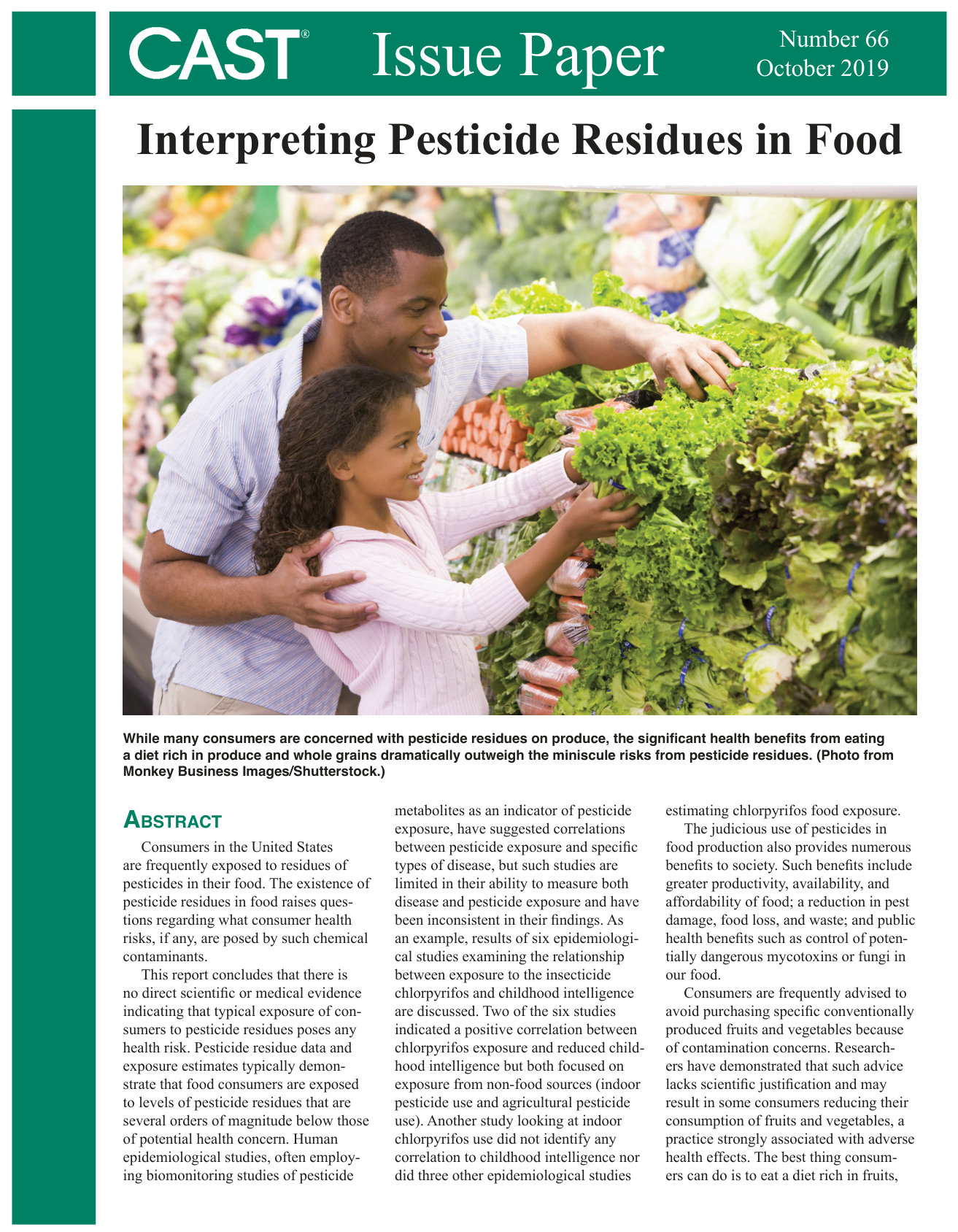
Consumers in the United States are frequently exposed to residues of pesticides in their food. The existence of pesticide residues in food raises questions regarding what consumer health risks, if any, are posed by such chemical contaminants. This report concludes that there is no direct scientific or medical evidence indicating that typical exposure of consumers to pesticide residues poses any health risk. Pesticide residue data and exposure estimates typically demonstrate that food consumers are exposed to levels of pesticide residues that are several orders of magnitude below those of potential health concern. Human epidemiological studies, often employing biomonitoring studies of pesticide metabolites as an indicator of pesticide exposure, have suggested correlations between pesticide exposure and specific types of disease, but such studies are limited in their ability to measure both disease and pesticide exposure and have been inconsistent in their findings. As an example, results of six epidemiological studies examining the relationship between exposure to the insecticide chlorpyrifos and childhood intelligence are discussed. Two of the six studies indicated a positive correlation between chlorpyrifos exposure and reduced childhood intelligence but both focused on exposure from non-food sources (indoor pesticide use and agricultural pesticide use). Another study looking at indoor chlorpyrifos use did not identify any correlation to childhood intelligence nor did three other epidemiological studies estimating chlorpyrifos food exposure. The judicious use of pesticides in food production also provides numerous benefits to society. Such benefits include greater productivity, availability, and affordability of food; a reduction in pest damage, food loss, and waste; and public health benefits such as control of potentially dangerous mycotoxins or fungi in our food. Consumers are frequently advised to avoid purchasing specific conventionally produced fruits and vegetables because of contamination concerns. Researchers have demonstrated that such advice lacks scientific justification and may result in some consumers reducing their consumption of fruits and vegetables, a practice strongly associated with adverse health effects. The best thing consumers can do is to eat a diet rich in fruits, vegetables, and whole grains, whether the foods are organic or conventional.Descargas
Los datos de descarga aún no están disponibles.
Descargas
Publicado
2019-10-21
Número
Sección
Issue Papers
Licencia
Derechos de autor 2019 Council for Agricultural Science and Technology (CAST)

Esta obra está bajo una licencia internacional Creative Commons Atribución-NoComercial 4.0.
License Terms for CC Attribution-NonCommercial 4.0:
License URL: https://creativecommons.org/licenses/by-nc/4.0/
License Terms Statement:
You are free to:
- Share — copy and redistribute the material in any medium or format
- Adapt — remix, transform, and build upon the material
Under the following conditions:
- Attribution — you must give appropriate credit, provide a link to the license, and indicate if changes were made
- NonCommercial — you may not use the material for commercial purposes
No additional restrictions — you may not apply legal terms or technological measures that legally restrict others from doing anything the license permits.
Cómo citar
Winter, C., Burns, C., & Savage, S. (2019). Interpreting Pesticide Residues in Food. Council for Agricultural Science and Technology (CAST). https://doi.org/10.62300/m95yp047