
Impact of Recruitment and Retention of Food Animal Veterinarians on the U.S. Food Supply
DOI:
https://doi.org/10.62300/h4j9xb26Palabras clave:
Food Supply, Veterinarian Recruitment, Veterinarian RetentionResumen
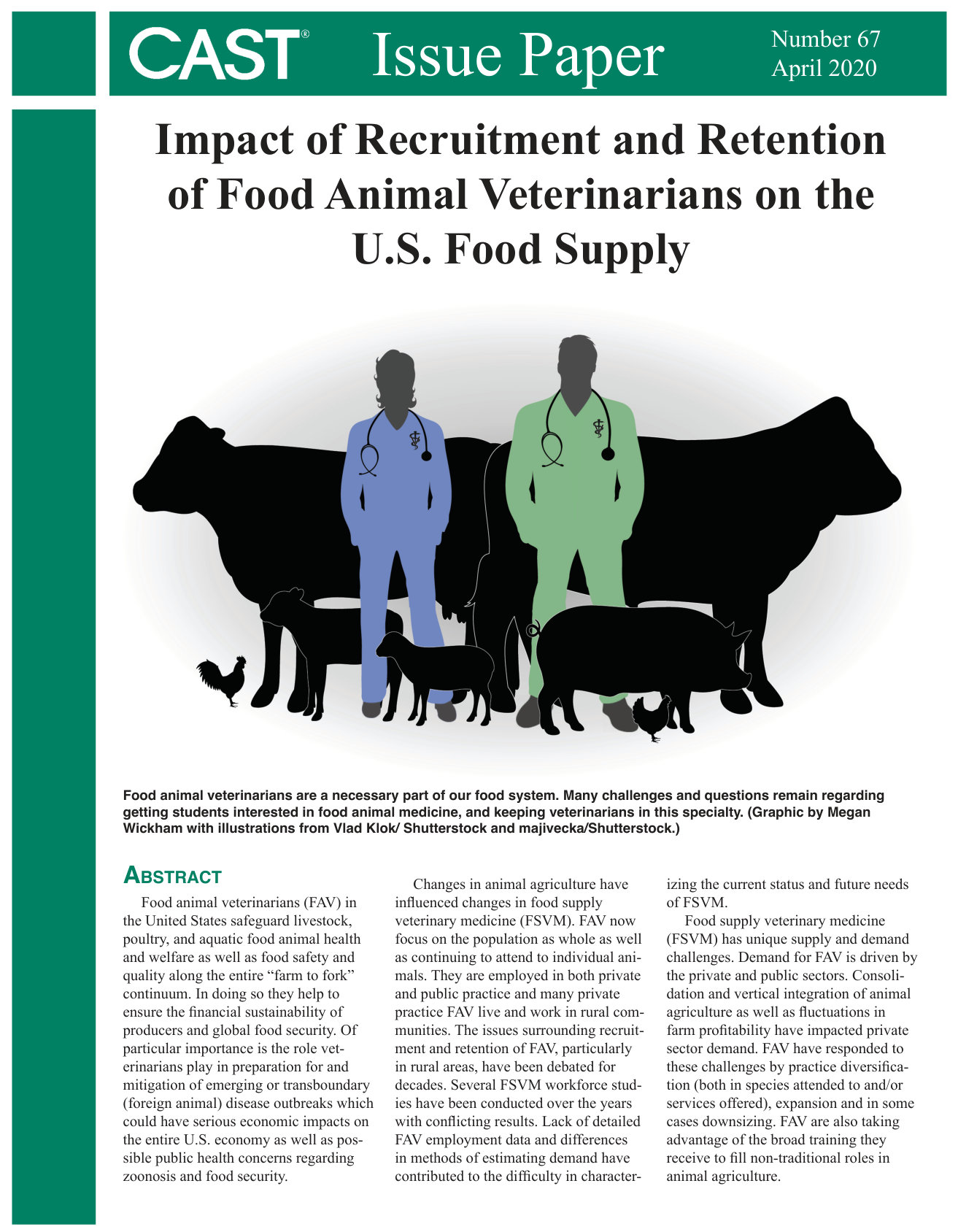
Food animal veterinarians (FAV) in the United States safeguard livestock, poultry, and aquatic food animal health and welfare as well as food safety and quality along the entire “farm to fork” continuum. In doing so they help to ensure the financial sustainability of producers and global food security. Of particular importance is the role veterinarians play in preparation for and mitigation of emerging or transboundary (foreign animal) disease outbreaks which could have serious economic impacts on the entire U.S. economy as well as possible public health concerns regarding zoonosis and food security. Changes in animal agriculture have influenced changes in food supply veterinary medicine (FSVM). FAV now focus on the population as whole as well as continuing to attend to individual animals. They are employed in both private and public practice and many private practice FAV live and work in rural communities. The issues surrounding recruitment and retention of FAV, particularly in rural areas, have been debated for decades. Several FSVM workforce studies have been conducted over the years with conflicting results. Lack of detailed FAV employment data and differences in methods of estimating demand have contributed to the difficulty in characterizing the current status and future needs of FSVM. Food supply veterinary medicine (FSVM) has unique supply and demand challenges. Demand for FAV is driven by the private and public sectors. Consolidation and vertical integration of animal agriculture as well as fluctuations in farm profitability have impacted private sector demand. FAV have responded to these challenges by practice diversification (both in species attended to and/or services offered), expansion and in some cases downsizing. FAV are also taking advantage of the broad training they receive to fill non-traditional roles in animal agriculture. Public sector demand is complicated by questions of societal perceptions of need balanced with government funding challenges. A rise in the popularity of non-commercial or “backyard” food animals puts further pressure on public health and brings a need for involvement of non-FAV in FSVM. Supply of FAV is influenced by both recruitment and retention factors, many of which are overlapping. One of largest barriers to recruitment and retention of all veterinarians is student debt. The educational debt accumulated during veterinary school to starting salary ratio is above what is considered acceptable. Solutions to high student debt have largely focused on mitigating it after the fact via loan forgiveness programs, in particular for FAV entering underserved rural practice areas. The largest of these is the federal Veterinary Medical Loan Repayment Program (VMLRP). The long-term effectiveness of these types of programs in other professions is debatable. The shortterm retention for the VMLRP is high but long-term retention not known. Challenges of rural life such as lack of social and cultural opportunities, lack of access to jobs for spouses, and childcare are of particular concern for recruitment and retention of FAV in rural communities. This is compounded by rural practices’ attributes such as long workdays and high on-call demands. The complex nature of these issues requires multifaceted solutions. Prior ties to the community are key factors in retention of physicians and physician’s assistants to rural communities. Recruiting potential students from geographical areas of need could be a priority in efforts to facilitate students returning to their geographical regions of preference as FAV professionals. Based on limited data, it appears that the demographics of FAV are different from veterinarians in general (older, male, less diversity of race and ethnicity). The reasons for this are not known but will be important to elucidate to help direct future recruitment and retentions efforts. Certain practice attributes such as caseload, facilities, and practice atmosphere and availability of mentorship are particularly important to retention. Better utilization of veterinary technicians/ nurses, telehealth, business and human resource skills can enhance both the financial and social qualities of a practice and improve recruitment and retention. Recruitment and retention of public practice FAV is also important. Lack of awareness of how veterinarians contribute to public health is a deterrent to FAV entering these fields. Adequate funding to support the training and hiring of FAV in public health fields is also important. Finally, robust training is needed for FAV to remain relevant to and meet the demands of animal agriculture. Training also fosters competence and employability, which are important to recruitment and retention.Descargas
Los datos de descarga aún no están disponibles.
Descargas
Publicado
2020-04-06
Número
Sección
Issue Papers
Licencia
Derechos de autor 2020 Council for Agricultural Science and Technology (CAST)

Esta obra está bajo una licencia internacional Creative Commons Atribución-NoComercial 4.0.
License Terms for CC Attribution-NonCommercial 4.0:
License URL: https://creativecommons.org/licenses/by-nc/4.0/
License Terms Statement:
You are free to:
- Share — copy and redistribute the material in any medium or format
- Adapt — remix, transform, and build upon the material
Under the following conditions:
- Attribution — you must give appropriate credit, provide a link to the license, and indicate if changes were made
- NonCommercial — you may not use the material for commercial purposes
No additional restrictions — you may not apply legal terms or technological measures that legally restrict others from doing anything the license permits.
Cómo citar
Navarre, C., Daniels, A., Johnston, M. O., Mathis, C., Perrett, T., Posey, D., Ramirez, A., Stough-Hunter, A., Telgen, C., Welch, D., & Widmar, N. O. (2020). Impact of Recruitment and Retention of Food Animal Veterinarians on the U.S. Food Supply. Council for Agricultural Science and Technology (CAST). https://doi.org/10.62300/h4j9xb26