
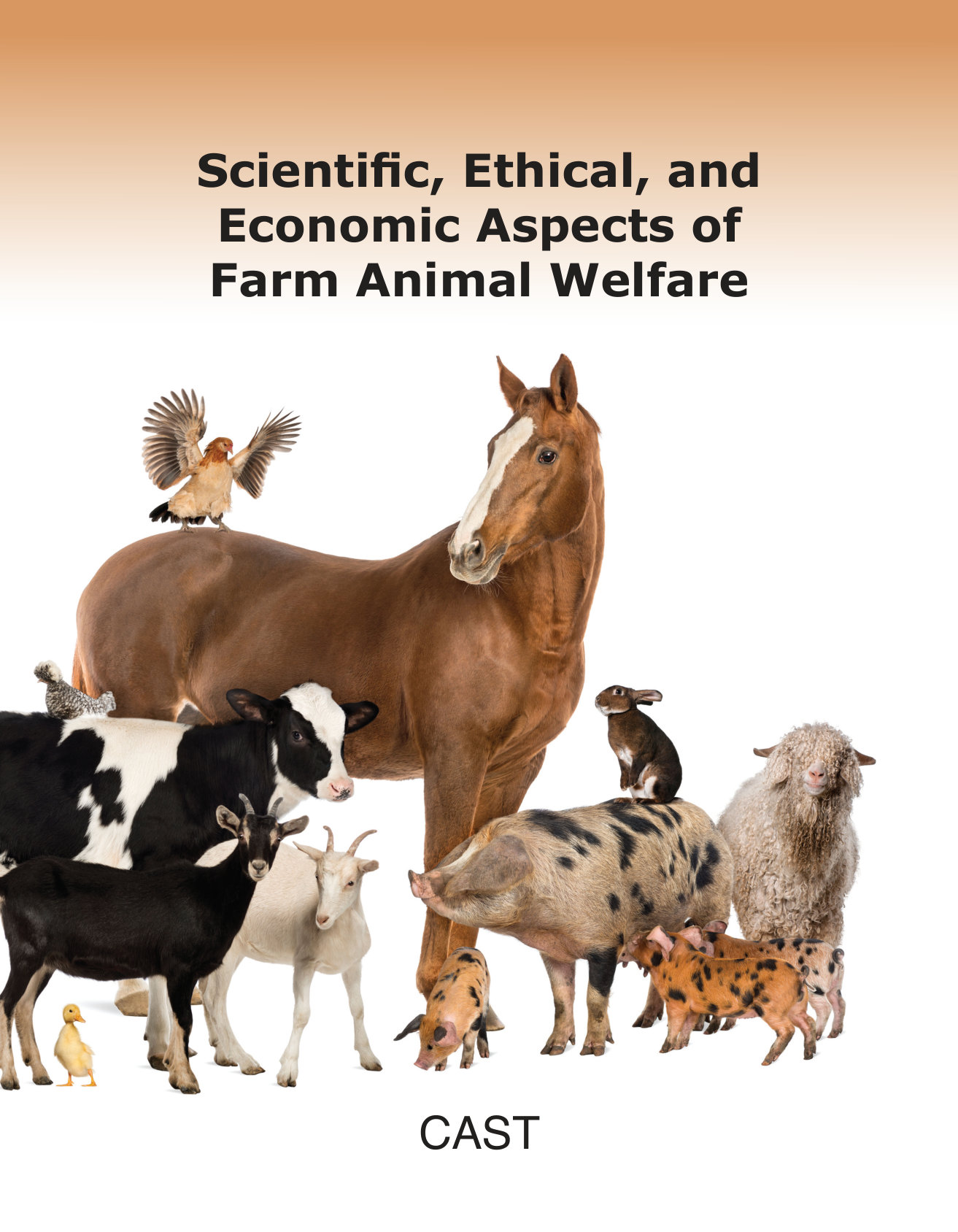
Scientific, Ethical, and Economic Aspects of Farm Animal Welfare
DOI:
https://doi.org/10.62300/dnhds381Keywords:
Animal Welfare, Animal EthicsAbstract
Many conflicting values and norms in our society related to the use of animals lead to increasing disagreements about what constitutes a “good life” for the animals in our care. Broadly speaking, applied ethicists have discussed two different approaches to this topic—one focuses on the consequences of using animals in particular ways, and the other on the morality of that use, regardless of the consequences. These two positions are reflected in the “animal welfare” and “animal rights” views, respectively. Another ethical perspective is that animals are owed a good standard of care because of the benefits we derive from them. Nevertheless, understanding both the science and the ethics of animal welfare is critical to understanding and reconciling differing perspectives about animal care and use. This task force report addresses the issue by examining these key topics: the current issues facing agricultural animal production, insights into the origins of current welfare concerns, major scientific advances that have occurred since the 1997 CAST Task Force Report, and outstanding challenges and priority areas for future research, coordination, and outreach relative to agricultural animal welfare.Downloads
Download data is not yet available.
Downloads
Published
2018-04-16
Issue
Section
Task Force Reports
License
Copyright (c) 2018 Council for Agricultural Science and Technology (CAST)

This work is licensed under a Creative Commons Attribution-NonCommercial 4.0 International License.
License Terms for CC Attribution-NonCommercial 4.0:
License URL: https://creativecommons.org/licenses/by-nc/4.0/
License Terms Statement:
You are free to:
- Share — copy and redistribute the material in any medium or format
- Adapt — remix, transform, and build upon the material
Under the following conditions:
- Attribution — you must give appropriate credit, provide a link to the license, and indicate if changes were made
- NonCommercial — you may not use the material for commercial purposes
No additional restrictions — you may not apply legal terms or technological measures that legally restrict others from doing anything the license permits.
How to Cite
Croney, C., Mench, J., Muir, W., Anthony, R., Golab, G., Hofacre, C., Hulet, M., Johnson, A. K., Lusk, J. L., Widmar, N. O., Schinckel, A. P., Shearer, J., Swanson, J., Thaxton, Y. V., & Varner, G. (2018). Scientific, Ethical, and Economic Aspects of Farm Animal Welfare. Council for Agricultural Science and Technology (CAST). https://doi.org/10.62300/dnhds381